
The submittal is due Thursday.
Who is writing it?
The one engineer who knows the sequence well enough is on site until six. The template you opened was written for a different scope, on a different job, for a different reviewer — and he has already sent two back.

You are editing somebody else’s method statement again.
You opened the last job’s RAMS because it was the thing that existed. You have changed the project name, the dates and about a third of the sequence. You already know which two thirds the reviewer is going to find.
It is not that nobody can write it. It is that the only people who understand the scope well enough are the same people the site cannot spare, and the submittal is due before either of those things changes.

The template is the enemy. It always was.
A template is a document written for a job that is not yours. It carries somebody else’s sequence, somebody else’s plant, somebody else’s hazards and somebody else’s hold points — and it is read by a person whose entire job is finding exactly that.
So it comes back. And the resubmission goes in later than the original was due, which is how a document that should have taken a day quietly costs a fortnight.

A rejected submittal does not delay a document. It delays the work.
No approved method statement, no permit. No approved ITP, no inspection. No approved material submittal, no delivery to site. The programme does not wait politely while the paperwork catches up — it slides, and then somebody is asked to account for the slide in front of people.
And by then nobody remembers that the whole thing began with an hour that did not exist on a Tuesday.
Written to your scope. Not around a template.
Send the scope, the drawings and the programme. This desk writes the method statement, the risk assessment, the ITP, the material or technical submittal, the HSE plan or the quality plan against the job you are actually doing — in the consultant’s own format, to their numbering, against the specification’s own clauses.
Comments come back as tracked revisions and go out again overnight, until it is approved. Where something is missing it asks you, because the one thing this desk will not do is invent site knowledge nobody gave it.
Six pages out of the seventeen, at actual size
A method statement and RAMS as a reviewer receives it — document control, the sequence, the hold points, and the regime it was written against.
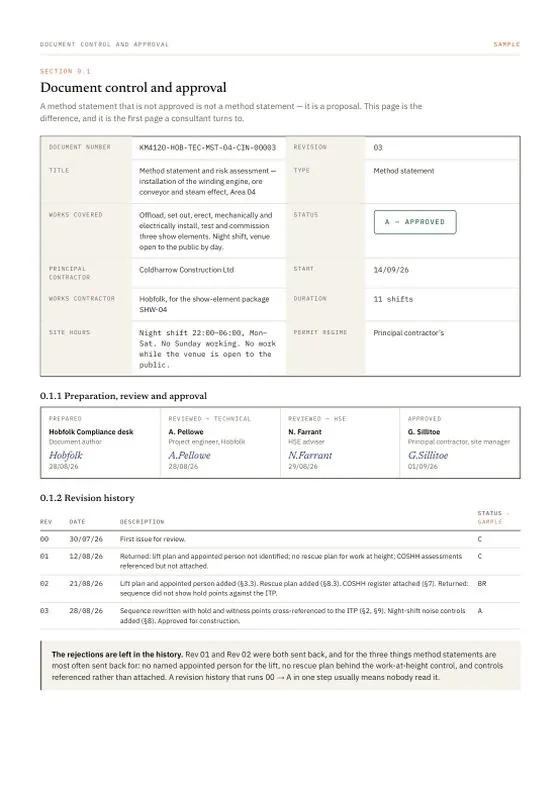
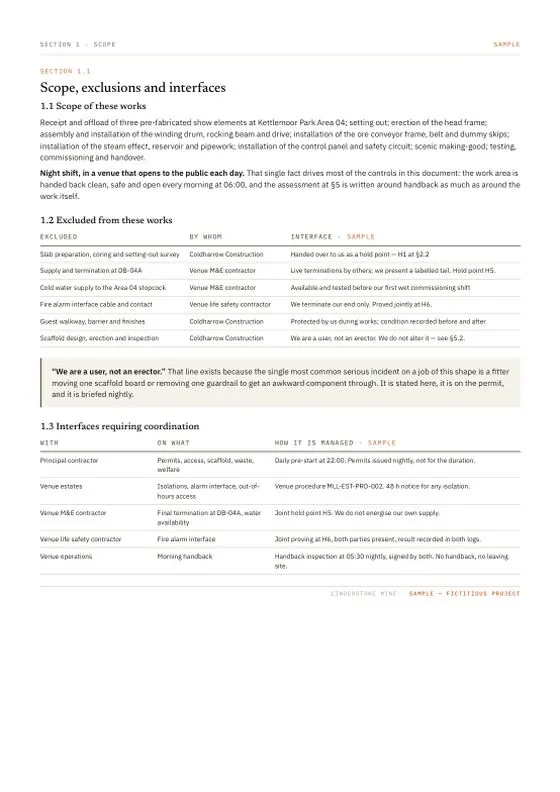
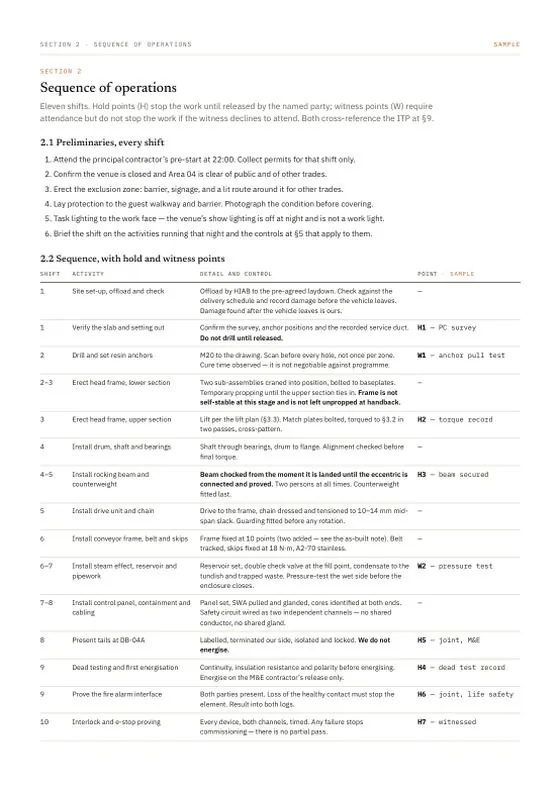
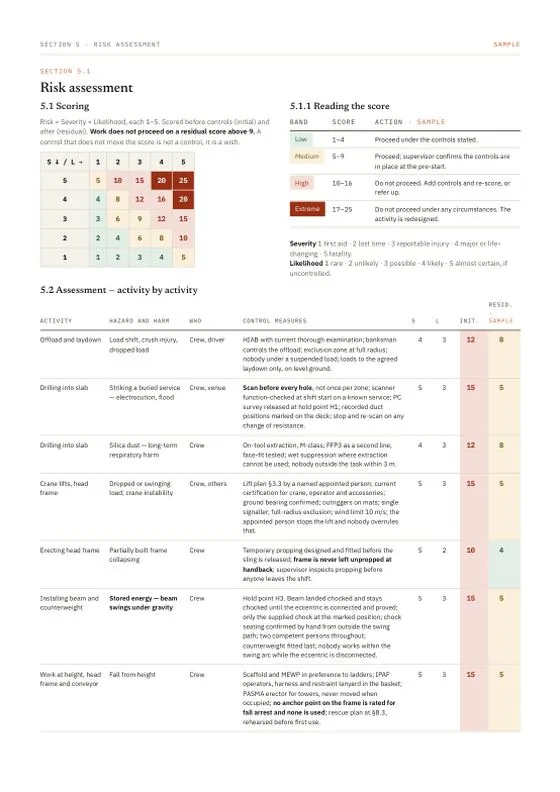
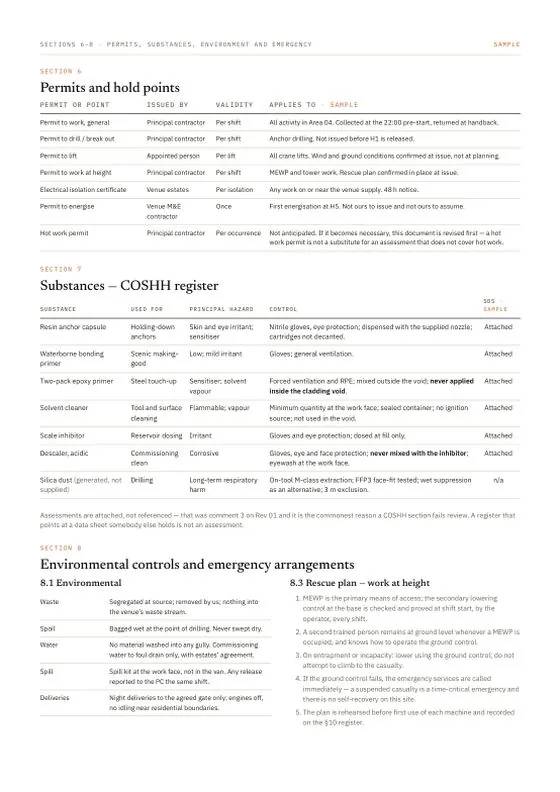
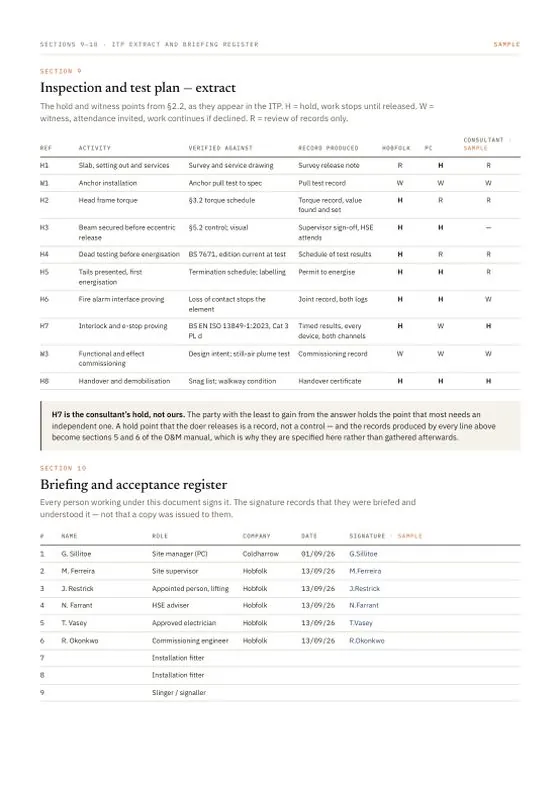
A full method statement and RAMS, written the way we write yours
Seventeen pages for a night-shift installation in a venue that opens to the public each morning: sequence of operations with hold and witness points, lift plan, competence matrix, a 5×5 risk assessment scored before and after controls, permits, COSHH register, rescue plan, an ITP extract and the briefing register. The revision history is left in, including the two revisions it was sent back on — and there is a page setting the UK duties against their Gulf equivalents, because the method survives translation and the regime does not.
Download the sample method statement (PDF)Cinderstone Mine is not a real project. Every client, contractor, document number, person and signature in it was invented for the sample — no content from any real job appears in it. The standards and frameworks cited are real and were verified current before use.

Specialists wrote the method. Nothing here marks its own homework.
The standard behind these documents was built with a practising health-and-safety and compliance specialist who has worked with us for years and knows what a reviewer strikes out and why. They designed the method, they advise on the hard ones, and they check the work.
Then a second desk with no stake in the answer tries to fault it, and a person reads it before you do. Every failure worth remembering reported success while it was failing — which is why “it ran” is never accepted here as evidence that it worked.
Your close of business is the start of the shift.
The document is a live file with a revision history and a submittal register, not an attachment that gets re-sent. It is written against the specification clause by clause, checked against a written standard, and re-checked when the scope moves.
The part that matters most is not clever at all: it is a desk that is working the revision while your site is closed, so the version that goes back in is waiting for you rather than the other way round.

A document department, without a document department.
The alternative is a document controller on the payroll, a consultant on day rate, or an engineer doing it at 22:40 instead of the thing you actually pay them for. This is the department on retainer — from £1,450 a month for one desk, no seat count, no usage meter, thirty days’ notice either way.
The first month is a paid trial at full price and full service, cancellable at the end of it with nothing to unwind. We would rather find out in four weeks than have you find out in six months.
The email says Status A.
The permit is issued. The inspection is booked against an approved ITP. The material is released and the delivery is on the programme it was always supposed to be on.
Nobody on your team stayed late for it, and the reviewer — who has never once been on your side — had nothing to send back.
A document written for your job gets approved. A document written for a different one gets returned.
What this desk will not do
Where this desk stops
- It prepares; the competent person signs. Where your sector requires a qualified safety adviser or a competent person’s sign-off, this desk writes the information and they approve it.
- Anything genuinely contested goes to a lawyer, and we say so rather than have a go.
Asked before, answered here
Is this a template with our project name dropped in?
What do you need from us to write one?
Will it pass our consultant’s review?
Do you work in our client’s format?
What about the O&M manual at the end?
Where are you, and when do you work?
The same guide, in short

The submittal date is coming whether the document is written or not.
Tell us what the job is and what the reviewer is asking for. We will tell you whether this desk can have it ready for that date.