
Written to your scope,
not around a template.
Method statements, risk assessments, inspection and test plans, material and technical submittals, HSE plans, quality plans, prequalification documents. Each one written against your project’s own scope, drawings and programme — not adapted from the last job’s file with the names changed. Wherever the job is.
A recycled method statement describes somebody else’s job
The reviewer has seen a hundred templated method statements this year. The one written to the actual scope is the one that stops collecting comments.
Most method statements are the last project’s document with the names changed — which is why they come back covered in comments. The plant list doesn’t match the lift, the sequence describes a site this job doesn’t have, and every resubmission cycle comes out of a programme that had no slack in it to begin with.
The alternative is not a better template. It is a document written from the job itself: the actual scope of works, the actual drawings, the actual plant, the actual interfaces with whoever else is on site. That takes longer to write the first time and less time to approve every time after, which is the only arithmetic that matters when the submittal date is fixed and the start date depends on it.
It is written from what you give this desk — the scope, the drawings, the programme, the site constraints only your people know. Where something is missing, the desk asks rather than assumes; what it never does is pad the gap with boilerplate that reads plausibly and describes nothing. A method statement that survives review is one that could only have been written about this job.
Everything below, not a menu underneath the menu
Method statements & risk assessments
Inspection & test plans
Material & technical submittals
HSE plans & safety documentation
Quality plans & prequalification documents
O&M manuals & handover packs
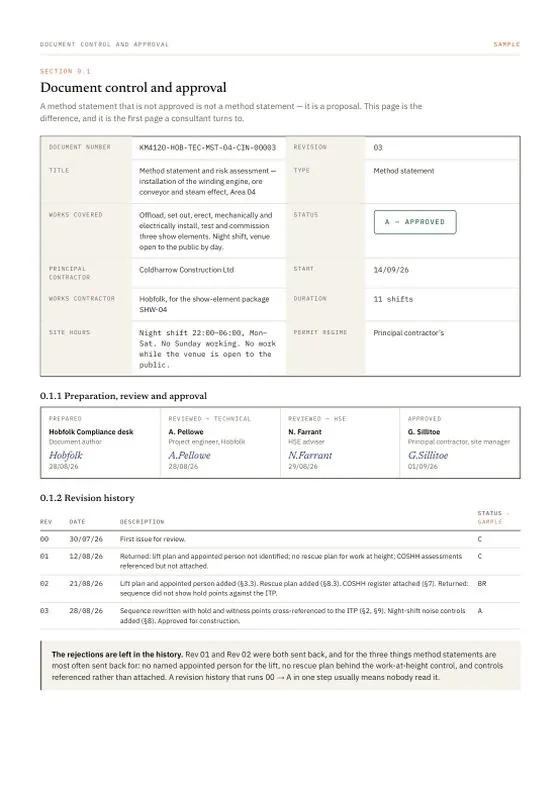
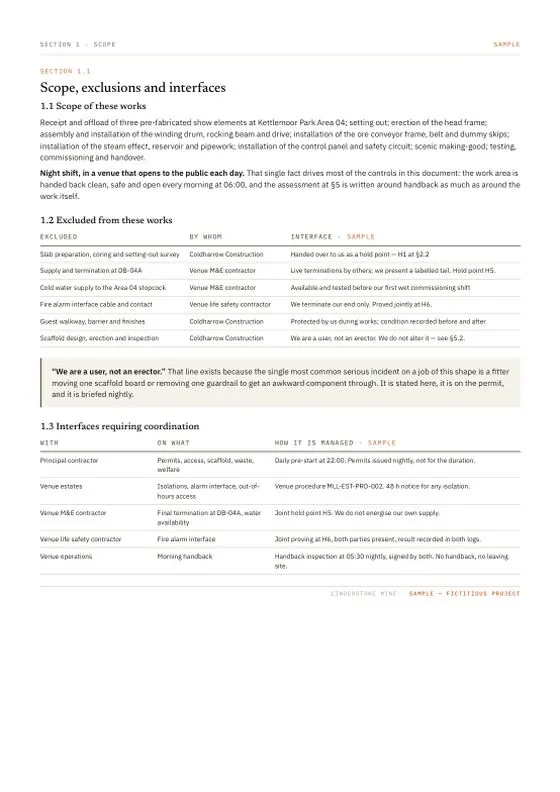
Six pages out of the seventeen, at actual size
A method statement and RAMS as a reviewer receives it — document control, the sequence, the hold points, and the regime it was written against.
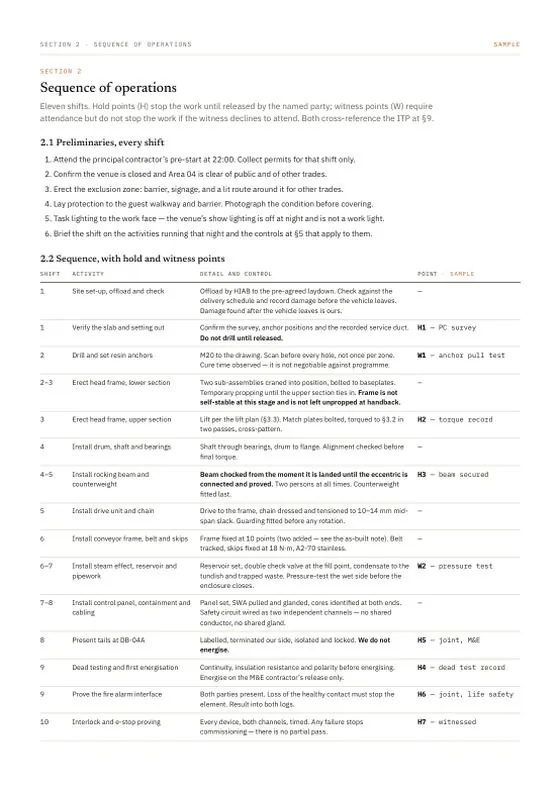
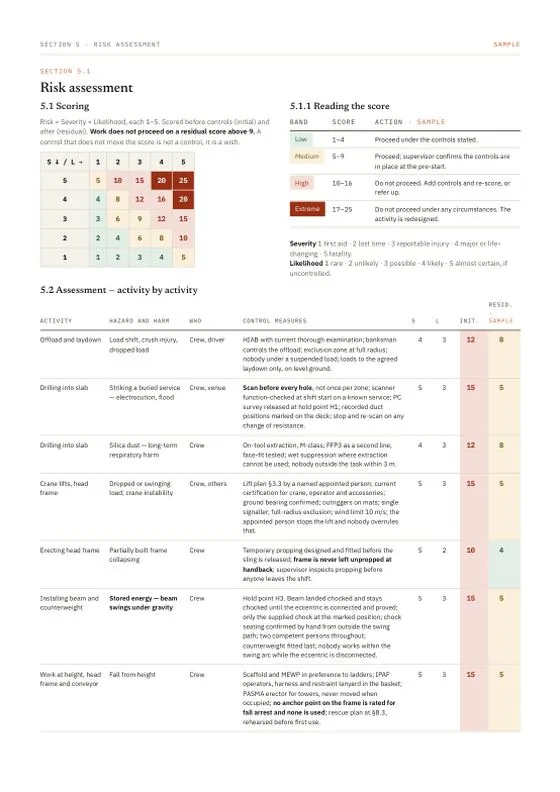
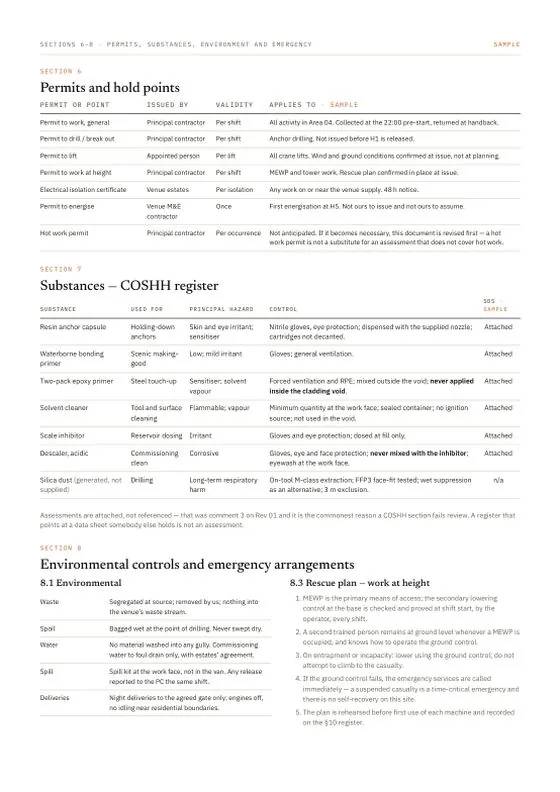
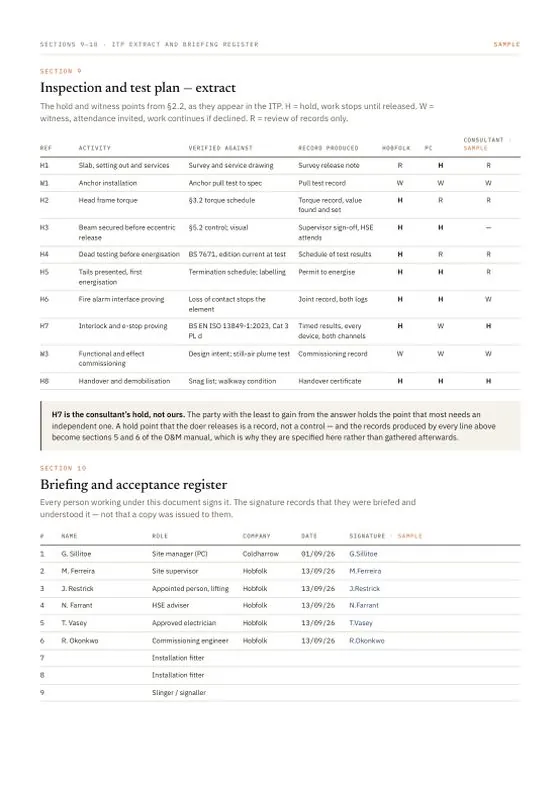
A full method statement and RAMS, written the way we write yours
Seventeen pages for a night-shift installation in a venue that opens to the public each morning: sequence of operations with hold and witness points, lift plan, competence matrix, a 5×5 risk assessment scored before and after controls, permits, COSHH register, rescue plan, an ITP extract and the briefing register. The revision history is left in, including the two revisions it was sent back on — and there is a page setting the UK duties against their Gulf equivalents, because the method survives translation and the regime does not.
Download the sample method statement (PDF)Cinderstone Mine is not a real project. Every client, contractor, document number, person and signature in it was invented for the sample — no content from any real job appears in it. The standards and frameworks cited are real and were verified current before use.
How a job moves through
The scope arrives
Scope of works, drawings, programme, plant list, site constraints. Whatever is unclear gets asked the same day.
The first draft is written to it
Sequence, plant, people and interfaces from the actual job — nothing carried over from anyone else's.
Your people review it
The person who will run the work reads it. If the sequence on paper is not the sequence on site, it changes now, not in review.
Comments turned around
The reviewing engineer's comments come back as a revision, not an argument — tracked, numbered, resubmitted.
Approved for use
The revision the crew is briefed on is the revision that was approved. One current document, never two.
Filed against the project
Every revision kept against the job — and feeding the handover pack, which is being assembled by the same desk as it goes.
What this desk will not do
Where this desk stops
- It prepares; the competent person signs. Where your sector requires a qualified safety adviser or a competent person’s sign-off, this desk writes the information and they approve it.
- Anything genuinely contested goes to a lawyer, and we say so rather than have a go.
Asked before, answered here
Is this a template with our project name dropped in?
What do you need from us to write one?
Will it pass our consultant’s review?
Do you work in our client’s format?
What about the O&M manual at the end?
Where are you, and when do you work?
The same guide, told as a story
This guide belongs to the Compliance desk
Compliance, documents & contracts
RAMS, O&M manuals, handover packs and a confidentiality agreement out before the drawings are.
Open the department Case studiesEvery case, in one place
Real, dated things that went wrong in the businesses this office already runs, and the fix each one produced.
See all the cases
The submittal date is coming whether the document is written or not.
Tell us what the job is and what the reviewer is asking for. We will tell you whether this desk can have it ready for that date. This desk on its own is from £1,450 a month, no seat count, thirty days’ notice either way — and the first month is a paid trial you can stop.