

It is the week before handover.
Where is the manual?
You already know the answer. It is in nine inboxes, two site diaries and one head that left the company in June — and the certificate is dated Friday.

Nobody planned to write it in the last week. Everybody does.
The job itself went well. That is the part no-one will remember. You are three tabs deep in a thread from March looking for a test certificate for a motor that was swapped on site in a hurry, and the only person who watched it happen is on another job in another county.
This is not happening because you are disorganised. It is happening because the pack was nobody’s job while the job was on. It became somebody’s job in the one week of the year you had the least of anything to give it.

The paperwork was never the dragon. The six-week gap is.
A drawing changed in April. A product was substituted in May. A warranty arrived as a photograph of a printout. On the day each of those happened the fact was free — one sentence from whoever was standing there.
Six weeks later every one of them is an archaeology job. That distance between the day a thing was true and the day you have to prove it is the thing eating your evenings. Every hour spent on a handover pack at the end is an hour spent paying interest on it.

A handover pack does not fail loudly. It fails on the day someone needs it.
Retention sits where it is while a consultant works through comments. Completion gets certified with a condition hanging off it. And then in November a client rings because something has stopped, and the manual names a part that was never fitted.
By that point it is not a paperwork problem. It is money you have earned and cannot draw, a client who now checks everything else you told them, and a phone call you have to take on a Sunday.

You are not writing a handover pack. You are being handed one.
This desk opens the manual as a live file on the day work starts. As-builts, substitutions, product data, warranties and certificates are filed against the job on the day they happen — and chased out of your suppliers when they do not arrive on their own.
You do less, not more: a word when something changed on site. On the day practical completion is certified the pack is complete, because it has been complete the whole way along.
A sample O&M manual: six of its forty-seven pages, at actual size
The sample O&M manual, opened. Not a contents list of what a pack could contain — the drawings, the certificates and the schedules that make a real one heavy.
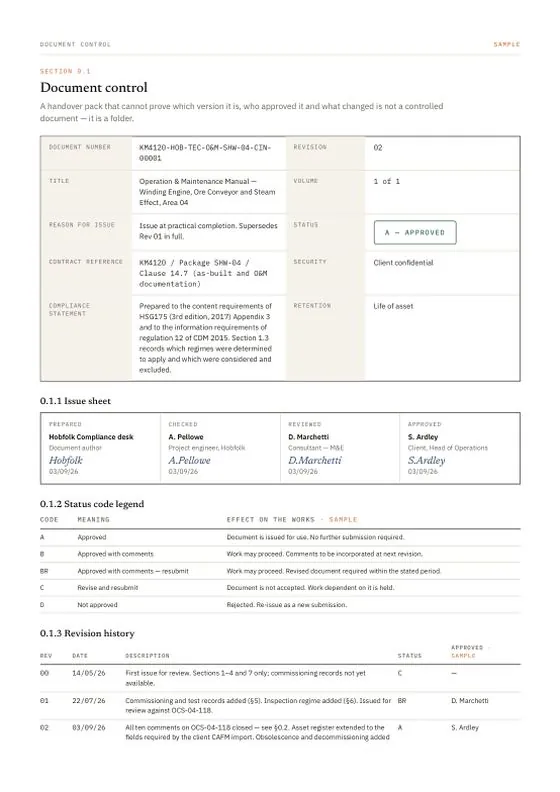
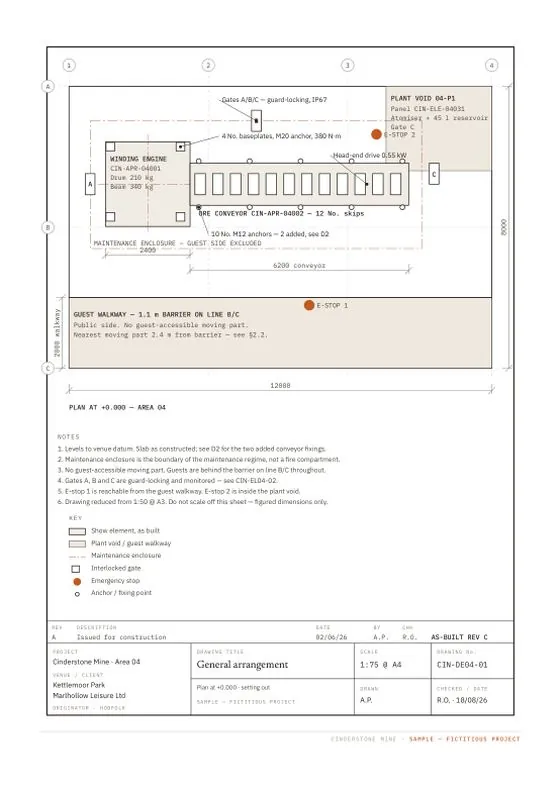
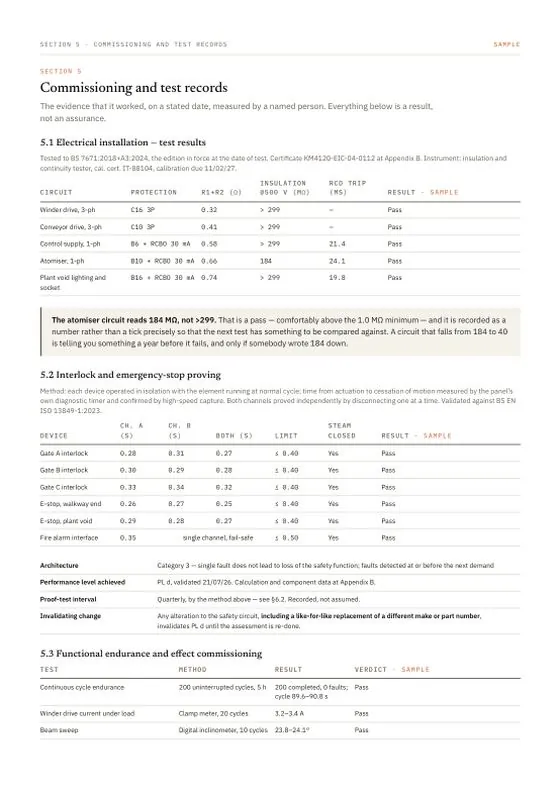
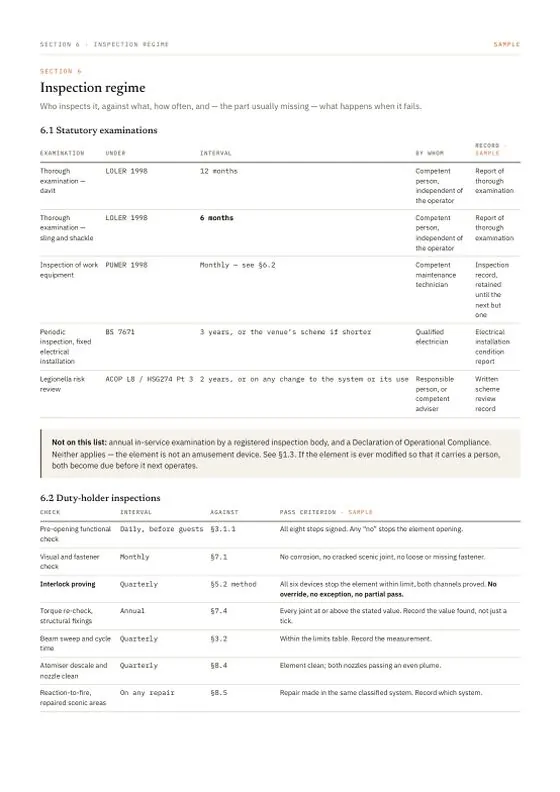
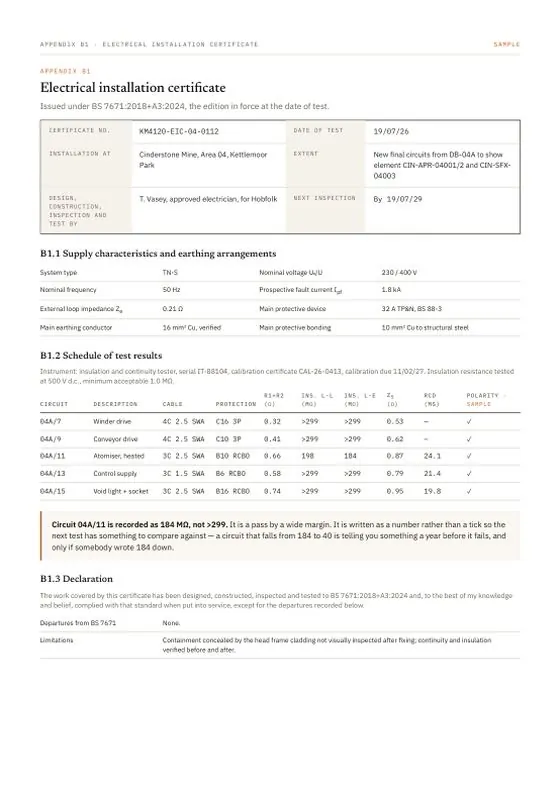
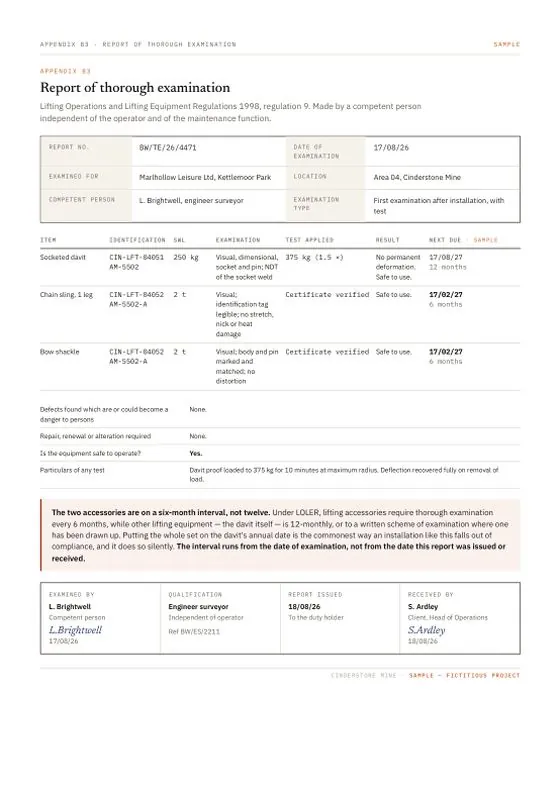
A complete sample pack, written the way we write yours
Forty-seven pages for a themed attraction — a whole pack, not a summary of one. Document control and a closed-out comment sheet; a page determining which statutory regime applies and which does not, with the reason; commissioning records including the test that failed; the inspection regime with a failure route for every line; torque, lubrication and obsolescence schedules. Then the half that makes a real handover pack heavy and that most samples leave out: six as-built drawing sheets, the electrical certificate and test results, the safety-circuit validation, the LOLER report, safety data sheets, warranties, coating data and the signage plate — bound in, not referenced.
Download the sample pack (PDF)Cinderstone Mine is not a real project. Every client, element code, drawing number, serial, colour and part reference in it was invented for the sample — no content from any real job appears in it. The regulations, standards and guidance cited are real and were verified current before use.

Specialists wrote the method. Nothing here marks its own homework.
The standard this desk writes to was built with a practising O&M, health-and-safety and compliance specialist who has worked with us for years and knows precisely what gets a pack sent back. They designed it, they advise on the hard ones, and they check the work. What you are buying is their method applied to your job every night, at a price their own time could never reach.
Then it is built to distrust itself. Every pack is checked against that written standard, handed to a second desk with nothing to gain from saying it is fine, and only what survives reaches a person — who reads it before you do.

A live file, a written standard, and something that assumes it is wrong.
The pack is a working document with a revision history, not a folder that gets zipped at the end. Entries are indexed as they arrive and cross-referenced as it grows, then validated line by line against the same standard your consultant is going to read it against.
That is very nearly the whole of the technology, and it is deliberately unglamorous. The hard part was never the software. It was doing it on the Tuesday, and then again on the Wednesday.

A whole department, for the nights you need one.
A document controller is a hire: a salary, a desk, a recruitment round, and one person who is idle in February and underwater in October. This is the department without the hire — from £1,450 a month for one desk, no seat count, no usage meter, no charge for asking it something twice, thirty days’ notice either way.
The first month is a paid trial at full price and full service. If it is not right you stop at the end of it and there is nothing to unwind.

Handover week, and there is nothing in your hands.
The pack goes out on the day it is certified. Comments come back and go into a revision cycle that is not yours to run. Retention moves. Nobody rings you in November.
And on the Thursday before handover, at 22:10, you are not looking for a certificate from March. You are looking at the next job.
The pack is not written at the end. It is finished at the end.
What this desk will not do
Where this desk stops
- It prepares; the competent person signs. Where your sector requires a qualified safety adviser or a competent person’s sign-off, this desk writes the information and they approve it.
- Anything genuinely contested goes to a lawyer, and we say so rather than have a go.
Asked before, answered here
Is this a template with our logo on it?
What do you need from us?
Does this work outside the UK?
The same guide, in short

Handover is coming whether the pack is ready or not.
Tell us what the job is and when it completes. We will tell you whether the pack can be ready for that date.